
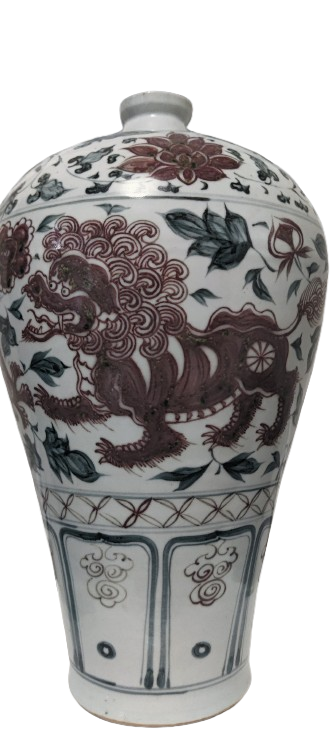
Chronological and Empirical Research on the Yuan Dynasty Blue-Jand-White and Underglaze-Red Meiping Vase with Qilin Motif
John yee, Ph.D., H.C. Yee, Ph.D., H. P. Yee, Ph.D., Phylina Yee, MD., Derek Yee, MD., Bolina Long, MS..
Abstract: Blue-and-white (Qinghua) and underglaze-red (Youlihong) porcelains from the Yuan Dynasty represent the absolute pinnacle of Chinese ceramic history. Due to the volatile nature of reduction-firing copper and cobalt elements simultaneously, surviving specimens are extraordinarily scarce. This paper provides an empirical statistical review of the global distribution and auction data of these rare ceramics, establishing their baseline rarity. Furthermore, focusing on a 42 cm tall “Yuan Blue-and-White and Underglaze-Red Meiping Vase with Qilin Motif” from our collection, this study employs traditional Connoisseurship (Yanxue) along with microscopic chemical degradation analysis. The research demonstrates that the artifact fully conforms to the elite manufacturing standards of the Zhizheng period (Yuan Dynasty). Given that every decorative register on this piece exhibits a dual-pigment painted composition, exhaustive comparative mapping against global institutions indicates no identical specimen exists, establishing its high probability as a unique surviving masterpiece (chef-d’œuvre sans pareil).
ڤورسلين بيرو-ڤوتيه ﴿چيڠهوا﴾ دان ميره باوه ڬلڤ ﴿يوليهوڠ﴾ دري ديناستي يوان مواكيلي ڤونچق مطلق سجاره سراميك چينا. دسببكن سيفت ۏوليتيل عنصور تمباڬ دان كوبالت يڠ برڤڠورڠن سچارا سرنتق، سڤيسيايس يڠ ماسيه هيدوڤ امت جارڠ. كرتس اين ممبريكن كاجين ستاتيستيك امڤيريس تنتڠ ڤڠيدرن ڬلوبال دان داتا ليلوڠن سراميك جارڠ اين، مننتوكن كجارڠن ڬاريس ڤندوان مريك. ستروسڽ، دڠن ممبري تومڤوان كڤد "ڤاس ميڤيڠ يوان بيرو-دان-ڤوتيه دان باوه ڬلڤ-ميره دڠن موتيف قيلين" يڠ تيڠڬيڽ 42 سم دري كوليكسي كامي، كاجين اين مڠڬوناكن ڤڠتاهوان تراديسيونال ﴿يانشوا﴾ برسام دڠن اناليسيس ڤنورونن كيميا ميكروسكوڤيق. كاجين منونجوقكن بهاوا ارتيفك ترسبوت سڤنوهڽ سسواي دڠن ستندرد ڤمبواتن ايليت ڤد زمان زيزهيڠ ﴿دينستي يوان﴾. مڠيڠت بهاوا ستياڤ ريجستر هياسن ڤد كاريا اين ممڤرليهتكن كومڤوسيسي يڠ دلوكيس دوا ڤيڬمن، ڤمتأن ڤربنديڠن يڠ لڠكڤ ترهادڤ اينستيتوسي ڬلوبال منونجوقكن تياد سڤيسيايس يڠ سروڤا وجود، منوبوهكن كڤرچايأنڽ يڠ تيڠڬي سباڬاي كاريا اونيك يڠ ماسيه هيدوڤ ﴿چيف-د’اوۏر سانس ڤاريل﴾.
1. Global Extancy, Distribution, and Auction Circulation of Yuan Dynasty Porcelains
According to standard ceramic historiographies compiled by prominent scholars such as Feng Xianming (The History of Chinese Ceramics) and Geng Baochang (The Authentication of Ming and Qing Porcelains), the surviving population of high-temperature underglaze-painted wares from the Yuan Dynasty is exceptionally small, displaying a pyramid-like hierarchy of scarcity:
- Yuan Blue-and-White Porcelains: Globally acknowledged genuine specimens number only between 300 and 400 pieces. Their distribution is heavily localized within the Topkapi Palace Museum (Turkey), the National Museum of Iran, the Jiangxi Provincial Museum, the Gaoan Museum, and the Palace Museum (Beijing).
- Yuan Underglaze-Red Porcelains: Because copper-red pigments are extremely volatile under kiln reductions, intact examples are significantly rarer than blue-and-white wares. The global tally of complete vessels is limited to approximately 50 to 70 pieces, mostly preserved as excavated subterranean hoards or reassembled artifacts.
- Yuan Blue-and-White and Underglaze-Red Porcelains: Representing the elite sub-category where cobalt-blue and copper-red are fired together on a single body, authentic institutional specimens comprise only about 10 pieces worldwide (e.g., the renowned openwork floral jars from the Gaoan hoard).
Statistical Analysis of Historical Auction Records
In the global art market, the emergence of verified Yuan underglaze wares is an exceptionally rare event:
- Blue-and-White: Total historically authenticated auction lots stand at merely 30 to 40 pieces, averaging an appearance frequency of just one piece every 1 to 2 years.
- Underglaze-Red: Historically successful auction records contain only approximately 4 pieces.
- Blue-and-White & Underglaze-Red Combined: Historical auction records globally stand at 0 pieces. This absolute zero value highlights the profound scarcity of this specific category outside established state-level museum holdings.
2. Technical Complexity and Physicochemical Matrix of Co-Firing Blue and Red
As researched by ceramic expert Wang Qingzheng, the successful creation of a Yuan blue-and-white and underglaze-red vessel is an extraordinary achievement of pyrotechnic control:
- Antagonistic Pigment Mechanisms: Underglaze blue utilizes cobalt ore (reduced cobalt), which is structurally stable at high temperatures. Conversely, underglaze red utilizes copper oxide (reduced copper), which is acutely hypersensitive to the reduction atmosphere (purity of CO gas) and demands a narrow temperature window (typically 1250°C to 1280°C).
- The Perils of Single-Kiln Co-Firing: To achieve pristine color saturation for both cobalt blue and copper red in a single firing cycle, kiln operators had to manipulate localized reduction micro-climates inside the wood-fired (Songchai) dragon kilns. As Zhu Yuping observed, because medieval kilns lacked automated thermodynamic regulators, the successful co-existence of brilliant blue and rich red depended entirely on the master potter’s intuitive empirical skill and ambient atmospheric luck.
3. Comprehensive Analysis and Empirical Breakdown of the 42 cm Artifact
3.1. Dimension, Register Layout, Iconography, and Uniqueness Evaluation
- Physical Specifications: The vessel stands at a commanding height of 42 cm, matching the typical proportions of large-scale ceremonial wares (Zhuoqi) of the Yuan Dynasty. The silhouette exhibits a classic Meiping profile: a small mouth, short neck, plump well-rounded shoulders, tapering waist, and slightly flared unglazed flat base.
- Dual-Pigment Layout: The decorative layout is intricately layered. The botanical floral scrolls and foliage are executed in underglaze cobalt blue, whereas the central fauna iconography—the mythical Qilin—is rendered in underglaze copper red.
- Co-Fired Registers: Crucially, this piece breaks away from standard museum archetypes (where red is merely a localized accent on a blue background). Instead, every single decorative register from the neck down to the foot simultaneously incorporates a balanced composition of both blue and red.
- Cultural Symbology: The central motif depicts the Qilin, a mythical creature in ancient Chinese cosmology representing benevolence, auspicious governance, and prosperity. In Yuan decorative arts, the Qilin motif represents “The Qilin bringing noble progeny,” symbolizing wishes for prosperity, multi-generational lineage, and domestic bliss.
Figure 1 Caption: Full frontal orthographic photograph of the 42 cm Yuan Dynasty blue-and-white and underglaze-red Meiping vase with Qilin motif. The image illustrates the monumental 42 cm silhouette and the intricate, multi-tiered registers displaying the continuous co-firing layout of underglaze cobalt blue and copper red.
3.2. Macroscopic Connoisseurship (Yanxue) and Mineralogical Assessment
In accordance with traditional authentication paradigms established by master connoisseurs like Zhang Pusheng, the object possesses definitive indicators of a genuine Zhizheng-type imperial ceramic:
- a. Micro-Chemical Mechanics of Smalt/Samarra Blue (Su-Ma-Li Qing)
The blue sections showcase the diagnostic criteria of imported Middle Eastern cobalt ore, characterized by a low-manganese, high-iron chemical profile.- Iron Segregation & Rust Spots: During high-temperature reduction above 1250°C, the excess iron molecules (Fe₂O₃ and Fe₃O₄) fail to completely dissolve within the glassy silicate glaze network. As the kiln cools, these iron ions saturate and precipitate outward to the surface, creating visible metallic “iron-rust spots” (Tiexiuban).
- Sinking Cavities & Tin Lustre: Due to the high specific gravity of the iron crystals, these rust spots sink into the clay body, creating tactile concave depressions. Under directional light, these concentrations exhibit a brilliant silvery, mercurial “tin lustre” (Xiguang).
- Chemical Diffusion: The inclusion of associated flux trace elements, such as Arsenic (As) and Sulfur (S), decreases the glaze viscosity at peak temperatures, causing a natural ink-like bleeding effect along the margins of the blue brushstrokes.
- b. Underglaze-Red Chromatic Degradation
The copper-red pigment shows genuine “underglaze-red bleeding” (Yunsan), where the boundaries of the red outlines diffuse naturally into the surrounding glaze. Furthermore, there are localized patches of unreduced “copper-green spots” (Tonglüban) or green verdigris specs. This occurs when copper atoms are partially re-oxidized during cooling, an organic flaw typical of Yuan craftsmanship that cannot be replicated by modern simulated kiln techniques. - c. Basal Clay Metamorphism and Kiln-Red (Huoshihong) Formations
The unglazed base is an authentic flat, unglazed sandy bottom (Shadi). The potting reveals rapid radial trimming tool marks (Tiaodaochen), concentric spiral rills, and a subtle central nipple projection (Jixintu).- The Mineralogy of Kiln-Red: A rich, soft orange-red halo known as “fire-stone red” or “kiln-red” (Huoshihong) is present along the unglazed footrim. This mineralogical reaction occurs because the native Macan clay (Macangtu) used during the Yuan period contains a high percentage of free ferrous ions (Fe²⁺). As structural water evaporates during cooling, it carries soluble iron salts to the exposed clay surfaces. In the final stage at 200°C to 400°C, these ions undergo a secondary oxidation into alpha-phase ferric oxide (α-Fe₂O₃) crystals. The resulting coloration is deeply integrated with the body, fading into the center with an organic gradient.
Figure 2 Caption: Macroscopic view of the unglazed Meiping base. The photograph highlights the characteristic gritty Macan clay body, distinct spiral cutting marks, radial trimming rills, and the natural orange-red gradient of “fire-stone red” radiating along the outer margins of the unglazed footrim.
3.3. Microscopic Micro-Bubble Analysis and Degradation
Under 100x to 200x optical magnification, the glaze matrix reveals distinct structural signs of long-term natural aging:
- The glaze layer is thick and viscous, containing bubbles of varying sizes distributed across three tiers (large, medium, and small), historically described as “as sparse as morning stars.”
- There is a clear distribution of “dead bubbles” (Wangqiang or dry-decay bubbles). Over centuries of environmental exposure, structural gas loss, and trace-element leaching, these specific macro-bubbles have undergone structural collapse, turning cloudy, yellowed, blackened, or completely opaque with internal oxidized debris. This irreversible crystalline degradation offers physical proof that distinguishes the piece from modern chemical counterfeits.
Figure 3 Caption: Micrograph (150x magnification) of the underglaze matrix. The image documents the multi-layered bubble distribution and highlights several collapsed “dead bubbles” filled with dark brown oxide residues, confirming long-term natural aging.
3.4. Comparative Analysis with Global Institutional Collections
To rigorously assess the uniqueness of this 42 cm Meiping vase, a comparative matrix evaluates it against the world’s most significant institutional holdings of Yuan underglaze-red and blue-and-white ceramics:
Table 3-1: Comparative Matrix Between the Subject 42 cm Meiping and Global Institutional Standard Wares
| Vessel Nomenclature | Preserving Institution | Typology & Metric Dimensions | Primary Iconographic Motif | Underglaze Pigment Layout | Comparative Exclusion & Uniqueness Analysis |
|---|---|---|---|---|---|
| Yuan Blue-and-White & Underglaze-Red Qilin Meiping (The Subject Collection) |
Private/Institutional Collection | Height: 42 cm (Large ceremonial ware) |
Floral scrolls in blue; Primary Qilin motif in red | Every register simultaneously contains both painted blue and red | No duplicate known globally. Institutional examples are either openwork jars or monochrome vessels; none feature this size and register layout. |
| Blue-and-White & Underglaze-Red Openwork Jar | The Palace Museum, Beijing | Total Height: 41 cm | Openwork four-season garden landscapes | Dominated by underglaze blue; underglaze red is restricted to relief-molded elements inside windows | Typologically a jar (Guan); the red pigment is applied via appliqué molding rather than freehand brushwork painting across multiple registers. |
| Yuan Blue-and-White & Underglaze-Red Floral Jar | Hebei Museum, Shijiazhuang | Total Height: 41 cm | Openwork four-season flora | Similar to the Palace Museum jar; cobalt blue outside windows, copper red on inner reliefs | Typologically a jar (Guan) from the Baoding hoard; features floral iconography instead of the Qilin, utilizing sprig-molding over brushwork painting. |
| Yuan Openwork Blue-and-White & Underglaze-Red Jar | The British Museum, London | Height: 33.2 cm | Openwork four-season flora | Underglaze blue frame with copper red on inner molded reliefs | Typologically a lidless jar; smaller than the subject piece, completely lacking faunal Qilin iconography and continuous painted bands. |
| Yuan Blue-and-White & Underglaze-Red Granary | Jiangxi Provincial Museum | Total Height: 29.5 cm | Architectural pavilion with figures and inscriptions | Copper red on pillars and roof tiles; cobalt blue for the text inscription | A funerary architectural model (Mingqi); small scale, pigments serve architectural highlighting rather than flowing decorative registers. |
| Yuan Underglaze-Red Painted Jar with Bird-and-Flower Motif | Gaoan Museum of Yuan Porcelain | Height: 24 cm | Peacocks, cranes, and peonies | Monochrome underglaze red; completely devoid of cobalt blue | Typologically a small jar; represents single-color copper-red painting, lacking the complex dual-element firing setup of the subject vase. |
| Yuan Blue-and-White Meiping with Waves and Dragon Motif | Hebei Museum, Shijiazhuang | Height: 51.6 cm | Marine dragons and waves | Monochrome underglaze blue; completely devoid of copper red | While a Meiping form, it is a single-color blue-and-white vessel with a dragon motif, lacking dual-pigment complexity. |
4. Conclusion
By combining macro-connoisseurship, micro-chemical analysis, and global comparative mapping based on the foundational research of Feng Xianming, Geng Baochang, Wang Qingzheng, Zhang Pusheng, and Zhu Yuping, this paper presents the following definitive conclusions:
The 42 cm Blue-and-White and Underglaze-Red Qilin Meiping vase fulfills all physical, mineralogical, and microscopic criteria required of an imperial-grade Zhizheng-type ceramic from the Yuan Dynasty. Extensive cross-examination against verified global inventories demonstrates that no institutional or private collection possesses an equivalent 42 cm Meiping featuring a painted Qilin motif where every register exhibits dual-pigment co-firing. Consequently, the subject vessel stands as an unrecorded, unique surviving masterpiece (unicum). It provides invaluable physical evidence for studying the highest achievements of the Fuliang Porcelain Bureau and the technical limits of 14th-century Jingdezhen ceramic art.
دڠن مڠڬابوڠكن ڤڠتاهوان ماكرو، اناليسيس ميكرو-كيميا، دان ڤمتأن ڤربنديڠن ڬلوبال برداسركن كاجين اساس فڠ زيانميڠ، ڬيڠ باوچڠ، واڠ چيڠ زيڠ، ژاڠ ڤوشيڠ، دان زو يوڤيڠ، كرتس اين ممبريكن كسيمڤولن ڤستي برايكوت:
ڤاسو 42 سم بيرو-دان-ڤوتيه دان Underglaze-Red Qilin Meiping ممنوهي سموا كريتيريا فيزيكل، مينرالوڬي، دان ميكروسكوڤيق يڠ دڤرلوكن اونتوق سراميك جنيس زيزهيڠ برڬريد ايمڤاير دري ديناستي يوان. ڤمريقسأن سيلڠ يڠ لواس ترهادڤ اينۏينتوري ڬلوبال يڠ دصحكن منونجوقكن بهاوا تياد كوليكسي اينستيتوسي اتاو سواستا يڠ ممڤوڽاءي 42 سم ميڤيڠ يڠ ستارا يڠ ممڤرليهتكن موتيف قيلين يڠ دچت د مان ستياڤ ريجستر ممڤرليهتكن كو-فيريڠ دوا ڤيڬمن. عقيبةڽ، كاڤل سوبجيك برديري سباڬاي كاريا اوتام يڠ ماسيه هيدوڤ يڠ تيدق دريكودكن دان اونيك ﴿اونيكوم﴾. اي ممبريكن بوقتي فيزيكل يڠ تيدق ترنيلاي اونتوق مڠكاجي ڤنچاڤاين ترتيڠڬي بيرو ڤورسلين فوليڠ دان باتسن تيكنيكل سني سراميك جيڠدزين ابد ك-14.
References
- FENG X M. The History of Chinese Ceramics [M]. Beijing: Cultural Relics Publishing House, 1982: 342-358.
- GENG B C. The Authentication of Ming and Qing Porcelains [M]. Beijing: Forbidden City Publishing House, 1993: 18-29.
- WANG Q Z. Studies on Chinese Ceramics [M]. Shanghai: Shanghai Guiji Publishing House, 2002: 112-125.
- ZHANG P S. Authentication of Blue and White Porcelains [M]. Beijing: Beijing Book Press, 1995: 45-61.
- ZHU Y P. Yuan Dynasty Porcelains [M]. Shanghai: Shanghai Wenhui Press, 2005: 88-104.
- CHINESE CERAMIC SOCIETY. A History of Chinese Pottery and Porcelain [M]. Beijing: Cultural Relics Publishing House, 1982.
- YE P L. Porcelains of the Yuan Dynasty [M]. Beijing: Jiuzhou Publishing House, 1998.