
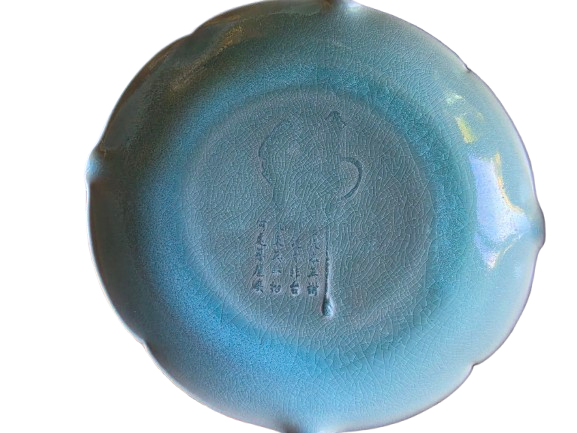
A Paradigm Shift in 12th-Century Imperial Wares: Typological and Epigraphical Analysis of a Thermoluminescence-Verified Ru-Type Octagonal Lobed Foliate Washer with Chan Buddhist Reliefs
John Yee, Ph.D., H.C. Yee, Ph.D., H.P. Yee, Ph.D., Philina Yee, MD., Derec Yee, MD., Balina Long, MS.
Abstract: This paper presents a groundbreaking material and epigraphical study of a newly surfaced, museum-grade Ru-type octagonal lobed foliate washer (Ruyao Baxian Huakou Xi), which uniquely integrates low-relief molding, Chan Buddhist epigraphy, and classical calligraphy into a single vessel. Traditional connoisseurship—predicated on the scholarship of S. Pierson, R. Krahl, and N. Wood—maintains that authentic 12th-century imperial Ru ware is characterized by post-firing incised short inventory marks (e.g., Fenghua, Cai, Jia) and that its thick, opacified lime-alkali glaze fundamentally precludes the legible execution of intricate low-relief calligraphic motifs. Furthermore, long-form poetic or religious inscriptions are traditionally attributed strictly to 18th-century Qianlong imperial lapidaries.
This specimen, however, features a low-relief molding of the iconic four-verse Chan gatha attributed to the Sixth Patriarch Huineng (“Bodhi originally has no tree…”), flanked by a monumental character for “Buddha” (Fo) executed in the fluid cursive tradition of Wang Xizhi. To reconcile this artifact with current typological paradigms, the author introduces scientific validation via Thermoluminescence (TL) testing, confirming a continuous material provenance of approximately one millennium.
To resolve the dialectical tension between established connoisseurship and empirical physics, this paper proposes two historical hypotheses: (1) a highly specialized, non-standard imperial commission for a high-status Chan monastic or imperial shrine during the late Northern Song dynasty; or (2) an exquisite lapidary intervention where late Jin, Yuan, or early Ming master-artisans engraved the vitrified glaze of an authentic, pristine Song heirloom vessel. This artifact serves as a critical nexus, fundamentally expanding our understanding of 12th-century ceramic engineering and the materialization of Song elite spirituality.
Keywords: Northern Song Dynasty; Ru Ware; Thermoluminescence (TL) Testing; Huineng Gatha; Wang Xizhi Calligraphy; Material Culture.