
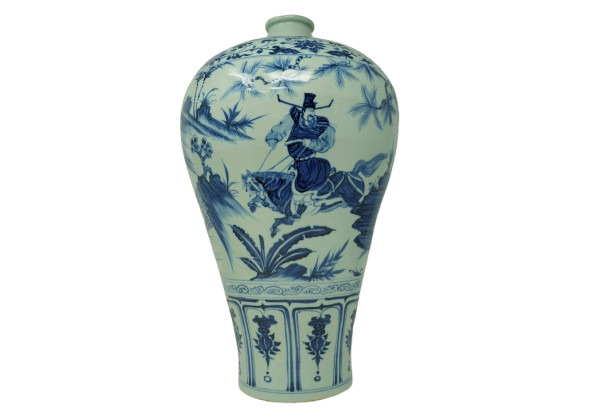
Archaeological Appraisal and Microscopic Analysis of a Late Yuan Dynasty Blue-and-White Meiping from Jingdezhen Kilns, a Comparative Study between a Private Collection and the National Treasure “Xiao He Chasing Han Xin under the Moonlight”
John Yee, Ph.D., H.C. Yee, Ph.D., H.P. Yee, Ph.D., Philina Yee, MD., Derek Yee, MD., Balina Long, MS.
Abstract
Blue-and-white porcelain from the late Yuan Dynasty represents a milestone in Chinese ceramic history, embodying the mastery of raw material formulation at Jingdezhen and the booming international art trade across the Mongol Empire. The “Xiao He Chasing Han Xin under the Moonlight” Meiping vase, excavated in 1950 from the tomb of Shengning King Mu Ying and now preserved in the Nanjing Museum, is hailed as the supreme masterpiece among all Yuan blue-and-white wares. This study contextualizes the historical background of Yuan porcelain and explores the pivotal role of Middle Eastern maritime and terrestrial trade in introducing Samarra cobalt. It compiles a checklist of 12 universally recognized or representative Yuan vessels adorned with continuous narrative scenes. Furthermore, a multi-dimensional connoisseurship and microscopic verification were conducted on a privately collected Meiping of the same iconographic motif. The results demonstrate that the private collection matches the baseline specimen in macroscopic decoration, dimensions, and cobalt glaze development. Microscopic analysis revealed authentic signatures of centuries-long aging, including decayed glaze bubbles, stable patina, and refractory iron-red on the exposed body, providing new material evidence for the cross-cultural artistic exchanges during the late 14th century.
ڤورسلين بيرو-ڤوتيه دري اخير ديناستي يوان مواكيلي ساتو ڤريستيوا ڤنتيڠ دالم سجاره سراميك چينا، يڠ مڠاندوڠي ڤڠواسأن فورمولاسي باهن منته د جيڠدزين دان ڤرداڬڠن سني انتارابڠسا يڠ بركمبڠ ڤست د سلوروه ايمڤاير موڠول. ڤاسو ميڤيڠ "Xiao He Chasing Han Xin under the Moonlight"، يڠ دڬالي ڤد تاهون 1950 دري قبور راج شڠيڠ مو ييڠ دان كيني دسيمڤن د موزيوم ننجيڠ، دڤوجي سباڬاي كاريا ترتيڠڬي د كالڠن سموا بارڠن بيرو ڤوتيه يوان. كاجين اين مڠكونتيك س لاتر بلاكڠ سجاره ڤورسلين يوان دان منليتي ڤرانن ڤنتيڠ ڤرداڬڠن ماريتيم دان دارت تيمور تڠه دالم ممڤركنلكن كوبالت سامرا. اي مڠومڤول سناراي ڤمريقسأن 12 كاڤل يوان يڠ دأكوي سچارا عموم اتاو ڤرواكيلن يڠ دهياسي دڠن اديڬن ناراتيف برتروسن. ستروسڽ، ڤڠتاهوان ڤلباڬاي ديمينسي دان ڤمريقسأن ميكروسكوڤيق تله دجالنكن ڤد ميڤيڠ يڠ دكومڤولكن سچارا ڤريبادي دڠن موتيف ايكونوڬرافي يڠ سام. حاصيلڽ منونجوقكن بهاوا كوليكسي ڤريبادي سسواي دڠن سڤيسيايس ڬاريس ڤندوان دالم هياسن ماكروسكوڤيق، اوكورن، دان ڤمباڠونن ڬلس كوبالت. اناليسيس ميكروسكوڤيق منونجوقكن تندا-تندا اوتام ڤنوءن سلاما برابد-ابد، ترماسوق ڬيليمبوڠ ڬلڤ يڠ روسق، ڤاتينا ستابيل، دان ميره بسي يڠ ريفراكتور ڤد بادن يڠ دددهكن، ممبريكن بوقتي باهن بارو اونتوق ڤرتوكرن سني لينتس بوديا سڤنجڠ اخير ابد ك-14.
I. Historical Evolution of Yuan Blue-and-White Porcelain and Middle Eastern Art Trade
Although blue-and-white porcelain roots trace back to the Tang and Song Dynasties, its true technical and aesthetic maturity emerged in the mid-to-late 14th century at the Jingdezhen Kilns. This transformation was driven by the Pax Mongolica, which reunited the Eurasian continents and established bustling sea and land Silk Roads.
The signature aesthetic of Yuan blue-and-white relies on Samarra Cobalt (known in Chinese as Sumali Qing), a high-iron, low-manganese cobalt ore imported from Persia (modern-day Kashan, Iran). Islamic potters had utilized this cobalt for low-fired earthenware centuries prior. With the arrival of Persian and Arab merchants and the establishment of the Fuliang Porcelain Bureau by the Yuan court, Middle Eastern tastes—characterized by monumental vessels, dense multi-tiered registers, and geometric medallion layouts—intertwined with native Chinese porcelain technology, literati brushwork, and Yuan drama illustrations. These masterpieces served not only as premium export commodities (as evidenced by the vast collections in the Topkapi Palace and the National Museum of Iran) but also as imperial rewards for noble elites, marking the zenith of cultural synthesis among Han, Mongol, and Islamic artistic traditions.
II. Global Checklist of Recognized Yuan Blue-and-White Vessels with Narrative Scenes
While floral and faunal decorations dominated the era, vessels depicting continuous historical narrative scenes are extremely scarce due to the demanding painterly precision required. The following 12 items denote the globally acknowledged and most representative narrative wares:
| No. | Vessel Description | Dimensions | Iconographic Narrative Motif | Current Repository / Source |
|---|---|---|---|---|
| 1 | Blue-and-White “Xiao He Chasing Han Xin” Meiping | H: 44.1 cm | Xiao He, Han Xin, and the ferryman (Records of the Grand Historian) | Nanjing Museum, China |
| 2 | Blue-and-White “Four Appreciations” Meiping | H: 38.7 cm | Wang Xizhi (Orchids), Tao Yuanming (Chrysanthemums), Zhou Dunyi (Lotus), Lin Hejing (Plum Blossoms) | Wuhan Museum, China |
| 3 | Blue-and-White “Gui Gu Zi Descending the Mountain” Jar | H: 27.5 cm | Sage Gui Gu Zi in a tiger-and-leopard chariot rescuing Sun Bin | Overseas Private Collection (Sold at Christie’s London, 2005) |
| 4 | Blue-and-White “Three Visits to the Thatch Hut” Jar | H: 27.6 cm | Liu Bei, Guan Yu, and Zhang Fe visiting Zhuge Liang | Pegasus Foundation, UK |
| 5 | Blue-and-White “Yuchi Gong Saving the Lord” Jar | H: 27.8 cm | General Yuchi Gong rescuing Li Shimin on horseback | Museum of Fine Arts, Boston, USA |
| 6 | Blue-and-White “Zhaojun Departing the Frontier” Jar | H: 28.4 cm | Wang Zhaojun journeying to the Xiongnu lands with a Pipa | Idemitsu Museum of Arts, Tokyo, Japan |
| 7 | Blue-and-White “Zhou Yafu at Xiliu Camp” Jar | H: 27.7 cm | Emperor Wen visiting General Zhou Yafu’s disciplined military camp | Museum of Oriental Ceramics, Osaka, Japan |
| 8 | Blue-and-White “Jinxiang Pavilion” Jar | H: 27.4 cm | The reunion of Chen Gui and Meng Yuemei from Yuan drama | The Chen Family Museum, USA / Christie’s 2026 |
| 9 | Blue-and-White “Romance of the Western Chamber” Jar | H: 28.0 cm | Cui Yingying burning incense, accompanied by Hongniang | Private Collection, Asia |
| 10 | Blue-and-White “Baihua Pavilion” Jar | H: 26.7 cm | Scene from the anonymous Yuan drama Wang Huan at Baihua Pavilion | Manno Art Museum, Japan (Former Collection) |
| 11 | Blue-and-White “Yuchi Gong Saving the Lord” Jar | H: 30.0 cm | Military confrontations between the Sui and Tang factions | Hengxian Museum, Guangxi, China |
| 12 | Blue-and-White “Four Appreciations” Meiping | H: 37.6 cm | Scholar-ideals of historical figures praising pure flora | Hubei Provincial Museum, China (Excavated from Prince Yingjing’s Tomb) |
III. The Supreme Standing of the “Xiao He Chasing Han Xin” Meiping and its Excavation
1. Why it is Recognized as the “First Porcelain” of Yuan Blue-and-White
The Nanjing Museum Meiping occupies an peerless status in Chinese ceramic history due to three factors:
- Unrivaled Craftsmanship: Standing at an impressive 44.1 cm, it utilizes imported Samarra cobalt to translate traditional ink-wash painting techniques—such as sketching, shading, and washing—directly onto dry porcelain clay, capturing the cool, desolate atmosphere of a moonlit river.
- Impeccable Preserved State: Unlike most excavated narrative shards, this pristine specimen exhibits zero cracks, chips, or restorations; its glaze retains a glowing brilliance.
- Archaeological Context & Exhibition Bans: As a scientifically recovered piece with clear terminal chronology, it has been designated by the State Administration of Cultural Heritage as a Grade-I National Treasure banned from international exhibition.
2. Excavation History and Museum Repository
The Meiping was unearthed in 1950 from the tomb of Mu Ying (the Duke of Qianning and a founding general of the Ming Dynasty) located at Jiangning District, Nanjing. Shortly after the tomb was illicitly opened by a local looter named Kang Yonghai, the vase was offered for sale around the Xinfengkou neighborhood in Nanjing. Chen Newmin, a connoisseur working for the Nanjing Antiquities Company, recognized its unparalleled historical weight and acquired it for the state. It was transferred to the Nanjing Museum, where a dedicated gallery houses it permanently as their crown jewel.
IV. Mineralogical Properties of Ma’an-cang Clay (麻仓土) and its Chronological Diagnostics
Throughout the ceramic history of Jingdezhen from the Yuan to the mid-Ming Dynasty, Ma’an-cang clay (mined from Ma’an-cang Mountain in Dongbu, Jingdezhen) was an imperial monopoly. It acted as the physical linchpin enabling the transition from a unitary formula (porcelain stone alone) to a binary formula (porcelain stone plus kaolin). Its idiosyncratic mineralogical hallmarks provide the most vital geochemical shield separating genuine late Yuan masterpieces from early Ming iterations and contemporary counterfeits.
1. Mineral Composition and High-Temperature Physics
Ma’an-cang clay is a premium hydromica-kaolinite clay characterized by a high aluminum (Al₂O₃) and low iron (Fe₂O₃) matrix.
- Refractory Elevation: The incorporation of Ma’an-cang kaolin boosted the alumina content of the raw clay paste to over 20%. This significantly raised the structural refractory limit, allowing the body to withstand sintering temperatures up to 1300°C without collapsing. It was this property that facilitated the production of unprecedentedly grand, distortion-free late Yuan shapes like massive jars and tall Meiping vases.
- Internal Porosity and Sub-Vitreous Interstices: Because Ma’an-cang was processed using rudimentary ancient levigation methods, minute particles of natural muscovite mica and quartz were preserved. Under high-temperature reduction, these impurities underwent phase transformations, generating sub-microscopic void structures within the fired body. Consequently, genuine Yuan paste achieves a distinct tactile paradox—“coarse but not loose, substantial yet physically lightweight.” It possesses a noticeably lighter handling weight relative to its volume when held side-by-side with denser modern reproductions.
2. Mechanistic Foundations of the “Slick Base” and “Refractory Red”
- The Glissade Base and Glutinous Rice Powder Texture: Due to the crystalline habit of its hydromica base, the unglazed exposed foot rim feels uniquely smooth to the touch, evoking the velvety texture of raw glutinous rice powder (known as Nuomi Tai), rather than the dry, abrasive scratching sensation indicative of modern crushed stone powders.
- Natural Migration of Refractory Red (火石红): Natural iron minerals were unevenly dispersed within the coarsely refined Ma’an-cang paste. During high-temperature reduction firing inside wood-burning (pine) dragon or egg-shaped kilns, internal moisture escaped outward, driving iron ions to migrate toward the unglazed clay surface. During the subsequent cooling cycle, these surface iron clusters re-oxidized into a multi-layered, semi-greasy, naturally haloed refractory red border along the glaze line. By the early Ming Dynasty (Hongwu and Yongle eras), the shallower veins of Ma’an-cang clay were depleted, forcing potters to harvest deeper strata that were chemically cleaner; hence, early Ming refractory reds appear more uniform, less greasy, and skew toward a paler tangerine hue. Contemporary high-fakes utilize modern synthetic chemical kaolin where iron is topically brushed on or mechanically mixed, yielding a static, flat coloration that lacks the organic, depth-outward bleed of authentic Ma’an-cang clay.
V. Macroscopic and Microscopic Examination of the Applicant’s Collection
To establish the authentication parameters of the applicant’s Meiping, a rigorous comparison against the Nanjing baseline specimen was implemented.
[ Figure 1 Placement: Full frontal macroscopic view of the privately collected Meiping ][ Figure 2 Placement: Roll-out schematic view of the narrative scene on the belly register ]
1. Integrated Macroscopic and Microscopic Comparative Matrix
| Diagnostic Vector / Physical Criteria | Nanjing Museum Baseline Standard (Exemplar) | Applicant’s Private Collection Performance | Analytical Deduction & Authentication Implication |
|---|---|---|---|
| Typology & Proportions | H: 44.1 cm. Characterized by a narrow mouth, flat lip, short neck, broad plump shoulder, and a tapering lower body with a shallow unglazed foot. | Overall height and volumetric ratios correspond seamlessly with the baseline within a standard variance tolerance. | Confirms structural conformity to late Yuan Dynasty manufacturing frameworks and historic press-mold/throwing specifications. |
| Cobalt Development (Samarra Cobalt) | Rich deep cobalt blue with distinct dark iron-rust blackish spots (Tiexiu Ban) aggregated in deep brush strokes, showing localized micro-depressions. | Deeply saturated blue development with organic iron-rust spot formation and an authentic tactile “eating into the body” effect. | Verifies the use of classic imported low-manganese, high-iron Persian ore, entirely disproving modern domestic chemical cobalt blends. |
| Iconographic Calligraphy & Linework | Free-flowing, continuous narrative. Translates Yuan drama woodblock aesthetics via masterful ink-wash methods. Rock formations utilize tadpole-like and unraveled-rope textures. | Mature, fluid brushwork. The physical cues of anxiety in Xiao He and hesitation in Han Xin are rendered dynamically without stuttering. | Demonstrates the confident, rapid execution of an authentic 14th-century artisan, free from the labored, tracing-induced pauses of modern forgers. |
| Glaze Micro-Morphology | Thick, unctuous vitreous layer with a jade-like depth. Displays scattered, partially crystalized “decayed bubbles” accrued over centuries. | Optical microscopy at 150x magnification reveals deflated, concave gas bubbles with dulled sheen and micro-crystalline surface aging. | Excludes rapid gas or electric kiln firing profiles. The localized presence of decayed bubbles acts as an unforgeable physical signature of deep temporal aging. |
| Paste Geochemical Signature (Ma’an-cang Clay) | Exposed base exhibits a pale grayish-white tone with a “glutinous rice flour” feel (Slick Base). Organic refractory red bleeding lines frame the glaze margin. | Unglazed base (Figure 5) reveals characteristic macro-porosity, a distinctive raw rice-powder slip texture, and an organically graduated iron-red halo. | Confirms the exclusive deployment of the historic Ma’an-cang binary paste formulation. Mechanically and tactilely isolates the ware from both early Ming variants and synthetic modern kaolin clays. |
[ Figure 3 Placement: Micro-photograph of the glaze layer showing decayedbubbles and aging patina ][ Figure 4 Placement: Photograph of the unglazed Meiping base showing refractory iron-red ]
Conclusion and Summary
Synthesizing the macroscopic iconographic analysis with microscopic criteria (including decayed bubble formations, natural surface patina, authentic refractory iron-red, and the definitive mineralogical touch of Ma’an-cang clay), the applicant’s “Xiao He Chasing Han Xin” Meiping displays all the chemical, material, and manual markers of a premium late Yuan Dynasty product fired at Jingdezhen. Its extreme stylistic proximity to the national specimen held in the Nanjing Museum marks it as an invaluable artifact for ceramic research and a masterpiece of early blue-and-white art.
مڽينتيسيس اناليسيس ايكونوڬرافي ماكروسكوڤيق دڠن كريتيريا ميكروسكوڤيق ﴿ترماسوق ڤمبنتوقن ڬيليمبوڠ يڠ روسق، ڤاتينا ڤرموكأن سمولا جادي، ميره بسي ريفراكتور يڠ اوتام، دان ڤنوتوڤ مينرالوڬي يڠ دفينيتيف دري تانه ليات ما'ان-چڠ﴾، ڤموهون "Xiao He Chasing Han Xin" Meiping ممڤاميركن سموا باهن كيميا، مانوال، دان ڤنچتوس ڤريميوم يوان ڤرودوق ديناستي دڤچت د جيڠدزين. كترڠن ڬايڽ يڠ ملمڤاو دڠن سڤيسيايس ناسيونل يڠ دسيمڤن د موزيوم ننجيڠ مننداكنڽ سباڬاي ارتيفك يڠ تيدق ترنيلاي هرڬڽ اونتوق ڤڽليديقن سراميك دان كاريا سني بيرو-ڤوتيه اول.
References
- Ma, Z. (Ed.). Illustrated Guide to Grade-I National Cultural Relics of China—Volume 1. Shanghai Lexicographical Publishing House.
- Nanjing Museum. The Capital of Six Dynasties: Selected Treasures of the Nanjing Museum. Cultural Relics Publishing House.
- Wang, Q. A Concise Dictionary of Chinese Ceramics. Shanghai Lexicographical Publishing House.
- Mikami, T. The Ceramic Road: Medieval Ceramic Trade Between East and West.