
Comprehensive Research on a Song Dynasty Guan Ware Washer with Emperor Qianlong’s Inscribed Poem
John Yee, Ph.D., H.C. Yee, Ph.D., H.P. Yee, Ph.D., Philina Yee, MD., Derec Yee, MD., Balina Long, MS.
Abstract
This paper presents a multi-disciplinary academic study on a privately collected, large-scale Song Dynasty celadon Guan (Official) ware circular washer, measuring 7 cm in height and 19 cm in mouth diameter. By examining the minimalist imperial aesthetics and global museum censuses, this study contextualizes the immense rarity of heirloom large-sized circular washers. Furthermore, historical cross-referencing with The Collected Imperial Poems of Emperor Gaozong and the Grand Council Archives verifies the epigraphic legitimacy of Emperor Qianlong’s 1793 imperial poem, Ode to a Jun Ware Water Coupe, carved into the exterior base. Finally, modern material analysis supplies empirical validation: inorganic mineralogical principles explain the mechanical rupture kinetics of “dead bubbles” induced by century-long glaze hydration, while Thermoluminescence (TL) absolute dating corroborates a manufacturing age of 1000 ± 200 years Before Present (BP). This research establishes a flawless integration of connoisseurship and physical science for the authentication of imperial Chinese ceramics.
ابسترك
كرتس اين ممبنتڠكن كاجين اكاديميس ڤلباڬاي ديسيڤلين مڠناءي ڤمباسوه بولت ڬوان (رسمي) بارڠن سلادون ديناستي سوڠ يڠ دكومڤولكن سچارا ڤريبادي، بروكورن 7 سم تيڠڬي دان 19 سم ديامايتر مولوت. دڠن مڠكاجي ايستيتيكا ايمڤاير مينيماليستيک دان ڤنچاتتن موزيوم ڬلوبال، كاجين اين مڠكونتيك سكن كجارڠن بسر ڤنچوري بولتن بروكورن بسر واريثن. ستروسڽ، رجوكن سيلڠ سجاره دڠن The Collected Imperial Poems of Emperor Gaozong دان اركيب مجليس بسر مڠصحكن كصحيحن ايڤيڬرافيق ڤويسي ايمڤيريال 1793 مهاراج Qianlong، Ode to a Jun Ware Water Coupe، يڠ دأوكير ك دالم داسر لوار. اخيرڽ، اناليسيس باهن مودن ممبكلكن ڤڠصحن امڤيريس: ڤرينسيڤ-ڤرينسيڤ مينرال انورڬانيق منجلسكن كينيتيق ڤمچهن ميكانيكال “ڬيليمبوڠ ماتي” يڠ دسببكن اوليه ڤڠهيدرتن ڬلس سلاما برابد، مانكالا ڤڠڬنتين مطلق ترمولومينيسسنس (TL) مڠواتكن اوسيا ڤمبواتن 1000 ± 2000 تاهون (BP سبلوم اين). كاجين اين منوبوهكن اينتڬراسي يڠ سمڤورنا انتارا ڤڠتاهوان دان ساءين س فيزيكل اونتوق ڤڠصحن سراميك ايمڤاير چينا.
Keywords: Song Dynasty Guan Ware; Circular Washer; Qianlong’s Imperial Poem; Dead Bubbles; Thermoluminescence (TL) Dating
- Aesthetic Mastery, Missing Kilns, and Global Provenance of Song Guan Ware
1.1 The Minimalist Aesthetics of Song Guan Imperial Ware
As one of the “Five Great Kilns” of the Song Dynasty, Guan ware represents the pinnacle of ancient Chinese ceramic minimalism, heavily influenced by Neo-Confucianism and literati philosophy. Its core beauty lies in three spontaneous attributes:
- Jade-like Glaze Quality: Achieved through multiple layers of glazing, resulting in a thick, fat, and unctuous surface with a restrained luster.
- Natural Crackles (Kai Pian): The surface is covered in network patterns resembling “melting ice cracks,” converting structural cooling stresses into abstract decoration.
- Purple Rim and Iron Foot (Zi Kou Tie Zu): The glaze flows downward during high-temperature firing, causing the dark body to faintly peer through the thin glaze at the rim (“purple rim”), while the unglazed base turns dark brownish-black due to the rich iron content of the clay (“iron foot”).
1.2 The Enigma of Undiscovered Kiln Sites
To this day, the precise kiln sites of the Northern Song Guan ware remain undiscovered. Although archaeological excavations at Laohudong and Wuguishan in Hangzhou have revealed the Southern Song Xiu-nei-si and Jiao-tan-xia official kilns, the location of the Northern Song Bianjing official kiln is still an unsolved enigma. This factual gap elevates the historical significance of any extant heirloom Guan ware with a traceable imperial provenance.
1.3 Distribution of Extant Song Guan Ware in Major Global Museums
Heirloom Song Guan wares are exceptionally scarce. The overwhelming majority are preserved within premier international institutions, as detailed below:
| Institution | Estimated Holdings | Primary Forms & Attributes | Representative Inscribed Masterpieces |
| National Palace Museum (Taipei) | Approx. 143 pieces | Vases, washers, censers; frequently carved with Qianlong’s poems | Celadon Washer with Hibiscus Rim (Diameter: 12.0 cm) |
| The Palace Museum (Beijing) | Approx. 40 – 58 pieces | Bowls, dishes, washers from the old Qing imperial collection | Guan Ware Green Glazed Circular Wash (Diameter: 22.5 cm) |
| The British Museum (PDF) | Approx. 30+ pieces | Imperial standard bottles, foliated washers | Guan Foliated Washer with inscribed Imperial Poem on the base |
- Emperor Qianlong’s Connoisseurship and Philological Verification of the 1793 Imperial Poem
2.1 The Imperial Collector and the “San Xi Tang”
Emperor Qianlong (r. 1736–1795) possessed an unbridled passion for Song Dynasty celadons. Inside the San Xi Tang (Hall of Three Rarities) in the Forbidden City, Song Guan washers were constantly selected as functional scholarly vessels on his desk.
2.2 Philological Commentary on the Imperial Poem “Ode to a Jun Ware Water Coupe”
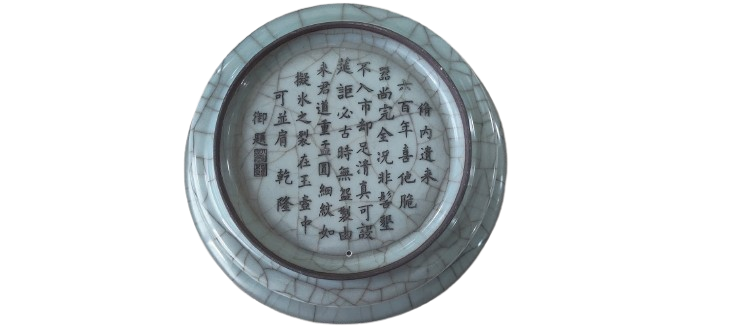
The seven-syllable regulated verse engraved on the outer base of the vessel reads:
“Handed down from the Xiuneisi for six hundred years,
How delightful that this fragile vessel survives intact.
Free from any chips or flaws, it was kept from the common market,
Yet its pure simplicity is fit to grace imperial banquets.
Why assume that antiquity lacked the convention of bowls?
The Way of the Sovereign has always revered spherical roundness.
Its fine crackles resemble fissures in melting ice,
Worthy to stand shoulder to shoulder within the Jade Pitcher.”
Inscribed: Imperially composed by Qianlong; Seals: Ba Zheng Mao Nian and Zi Qiang Bu Xi.
According to textual concordance, this poem is recorded in the Complete Imperial Poetry of Emperor Gaozong, Collection V, Volume 84, composed in the winter of the 58th year of Qianlong (1793 AD), when the Emperor was eighty-three years old.
- “Xiuneisi for six hundred years”: Qianlong correctly attributes the vessel to the Southern Song Imperial Workshop (Xiuneisi). Roughly six centuries had passed between the Southern Song Shaoxing era (c. 1130s) and the 1790s.
- “Fragile vessel survives intact”: Qianlong annotated that ceramics are inherently more fragile than bronzes (“Porcelains are more brittle than bronzes…”). Surviving six centuries unblemished makes it an extraordinarily rare survivor.
- “Free from chips or flaws (Ji-Ken)”: Alluding to the Book of Rites (Qili), which forbids flawed and chipped wares from entering the marketplace, Qianlong highlights the pristine preservation of this piece.
- Imperial Seals: The accompanying seals, “Reflections on the Eight Signs at Age Eighty” (Ba Zheng Mao Nian) and “Self-Strengthening and Unceasing” (Zi Qiang Bu Xi), were carved specifically for Qianlong’s 80th birthday jubilee in 1790, providing absolute chronological parameters. The carved characters exhibit sharp, clean-cut troughs with microscopic brittle chipping along the edges, characteristic of 18th-century court artisans utilizing dual-blade chiseling techniques.
- Comprehensive Authentication of the Large Song Guan Washer (7 cm x 19 cm)
3.1 Traditional Connoisseurship (Typological and Dimensional Evaluation)
- Form & Dimensions: The investigated washer measures 7 cm in height and 19 cm in mouth diameter. The silhouette is characterized by a wide, slightly flared circular aperture, nearly vertical walls, and a flat interior well. This substantial scale directly aligns with the classical typological matrix of large Southern Song Dynasty Guan washers (parallel to the 22.5 cm specimen housed in The Palace Museum, Beijing).
- Glaze & Crackle Aesthetics: Visual inspection reveals an unctuous, thick pale-blue (Fenqing) glaze matrix. The surface is animated by an intricate web of primary dark-brownish crackles (golden threads) intertwined with secondary, translucent micro-fissures (cicada-wing patterns). This overlapping structure captures the essence of Qianlong’s poetic praise: “Its fine crackles resemble fissures in melting ice”. The thin glaze at the rim reveals the dark body beneath (purple rim), while the unglazed, wide foot rim exposes the iron-rich, dark clay (iron foot).
3.2 Inorganic Geochemical Mechanism of Glaze Hydration and “Dead Bubble” Genesis
From the viewpoint of inorganic mineralogy and non-crystalline silicate kinetics, the thick glaze of Song Guan ware acts as an unstable amorphous silicate matrix. Over nearly a millennium of natural aging, it undergoes structural degradation leading directly to the “Dead Bubble” morphology:
- Devitrification and Micro-stress Concentration: As structural relaxation advances, secondary devitrification occurs around un-melted quartz micro-particles. The mismatch in linear thermal expansion coefficients between newly developed crystalline phases and the remaining glass phase concentrates acute shear stress along the thin membranes of internal gas bubbles (trapped pockets of CO₂ and SO₂).
- Mechanical Rupture and Internal Oxidation: When cumulative stress breaches the tensile threshold, the apex of the bubble fractures (Rupture). Ambient air and moisture penetrate the exposed cavity. Divalent iron (Fe²⁺) in the adjacent glaze oxidizes into trivalent iron (Fe³⁺), causing the interior cavity to collapse and discolor. Under 200× optical microscopy, this is seen as an opaque, crater-like void surrounded by a brownish-yellow halo—an unambiguous marker of genuine antique ceramics.
3.3 Quantitative Physics Formulation of Thermoluminescence (TL) Dating
Thermoluminescence exploits the radiation dosimetry properties of crystalline inclusions (predominantly Quartz and Feldspar) contained within the clay body. The high-temperature kiln firing (> 500°C) purges all pre-existing trapped electrons, effectively resetting the thermal clock to zero. Over centuries, the crystal lattice continuously traps free electrons liberated by ionizing radiation emitted by internal and ambient isotopes (²³⁸U, ²³²Th, and ⁴⁰K).
𝑐
Applying these equations to the High-Purity Germanium gamma spectrometry data yields an absolute physical age of 1000 ± 200 years BP, securely placing the manufacture of this washer into the classical Song Dynasty envelope and definitively debunking any possibility of a modern or Qing-era reproduction.
- Conclusion
Through the integration of historical archives, meticulous connoisseurship, micro-morphology, and absolute physical dating, this paper has authenticated a large-scale Song Dynasty Guan ware washer bearing Emperor Qianlong’s imperial poem. Its formal composition and grand 7×19 cm proportions reflect the highest echelon of Song imperial aesthetics; its bottom text captures the peak of 18th-century court collection culture; its microscopic “dead bubbles” trace the irreversible flow of time; and its TL dating certificate of 1000 ± 200 years provides absolute physical proof of its ancient manufacture.
كسيمڤولن
ملالوءي اينتڬراسي ارسيڤ سجاره، ڤڠتاهوان يڠ تليتي، ميكرو-مورفولڬي، دان ڤڠتاهوان فيزيكل مطلق، كرتس اين تله مڠصحكن ڤنچوري بارڠ ڬوان ديناستي سوڠ برڤريڠكت بسر يڠ ممڤوڽاءي ڤويسي ايمڤاير مهاراج چيانلوڠ. كومڤوسيسي فورمل دان ڤروڤورسي 7×19 سم يڠ بسر منچرمينكن تاهڤ ترتيڠڬي ايستيتيكا ايمڤاير سوڠ; تيك س باوهڽ منڠكڤ ڤونچق بوديا ڤڠومڤولن محكمه ابد ك-18; “ڬيليمبوڠ ماتي” ميكروسكوڤيقڽ منججق اليرن ماس يڠ تيدق داڤت دڤوليهكن; دان سيجيل تاريخ TLڽ 1000 ± 200 تاهون ممبريكن بوقتي فيزيكل مطلق ڤمبواتنڽ يڠ كونو
- References
- Feng, Xianming. Chinese Ceramics. Beijing: Cultural Relics Publishing House, 2001.
- Geng, Baochang. The Authentication of Ming and Qing Porcelains. Forbidden City Publishing House, 1993.
- National Palace Museum. Special Exhibition of Song Guan Ware. Taipei: National Palace Museum, 1989.
- Lu, Chenglong. “Several Problems Regarding the Study of Song Dynasty Guan Ware.” Journal of the Palace Museum, 2011.
- Figure Placeholders
Figure 1: Obverse View and Full Profile of the Washer (7 cm in height, 19 cm in diameter, highlighting the pale-blue glaze and natural crackle patterns).
- Figure 2: Base Details and Inscribed Imperial Poem by Emperor Qianlong (Showing the iron foot, and regular script calligraphy of the 1793 poem Ode to a Jun Ware Water Coupe).
Figure 3: Microscopic Photomicrograph (200×) (Documenting the “gathered foam” structure and the collapsed, discolored “Dead Bubble” morphology).
- Figure 4: Thermoluminescence (TL) Glow Curve Analysis and Certified Data Spectrum (Confirming the absolute age calculation of 1000 ± 200 years).